

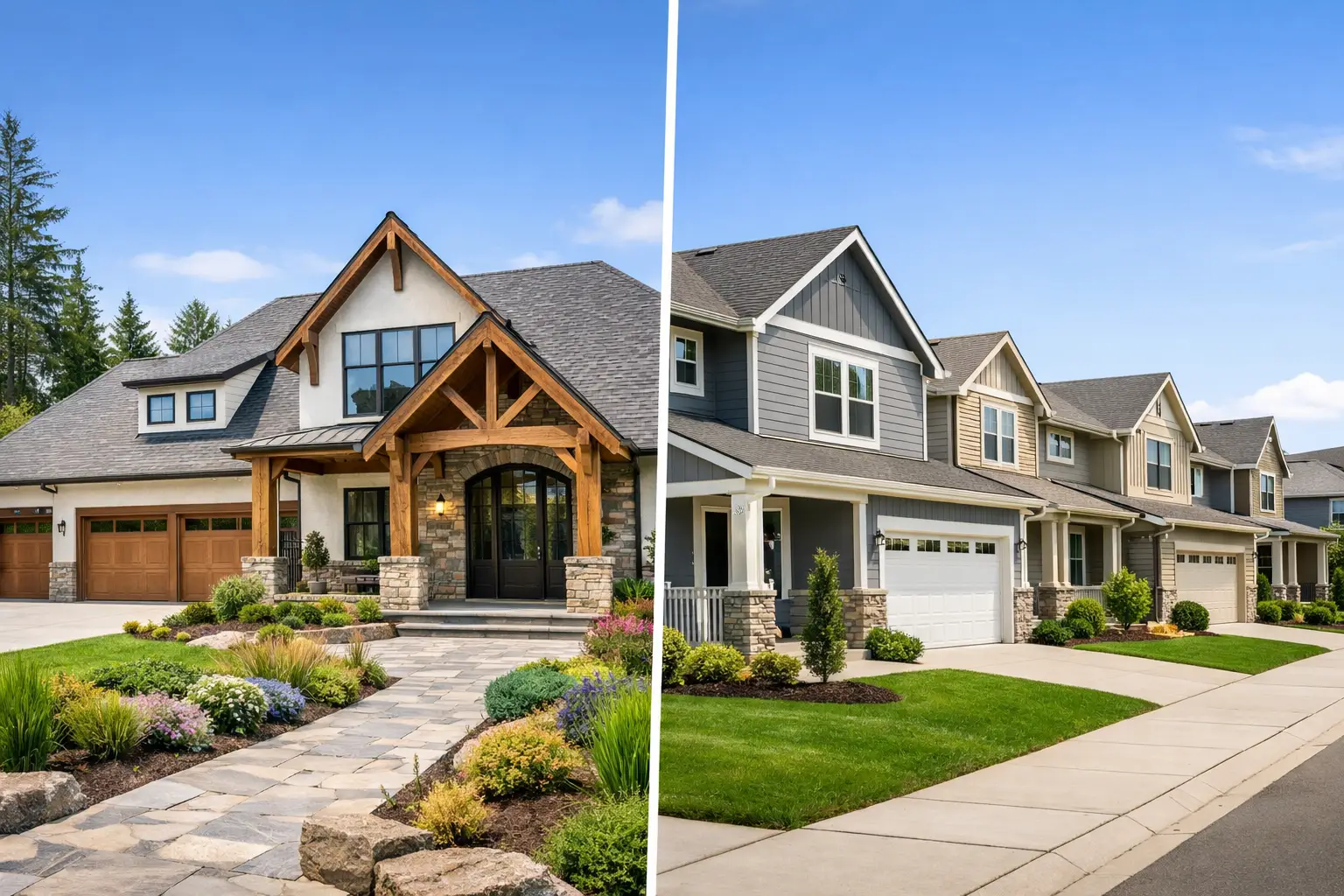
Custom Home vs Production Home: Which Fits?
A floor plan can look perfect on paper and still feel wrong once you imagine your daily life inside it. That is usually where the custom home vs production home decision gets real. One path offers speed and predictability. The other gives you far more control over how your home looks, lives, and grows with your family.
For Denver-area homeowners making a major investment, this choice is not just about style. It affects your budget, build timeline, lot options, level of involvement, and long-term satisfaction. The right answer depends on what matters most to you and where you are willing to compromise.
Custom home vs production home: the core difference
A production home is built from a set menu of plans, finishes, and structural options. Builders often develop many homes in the same community, using repeatable systems to keep pricing and timelines more consistent. You usually choose from a handful of layouts, exterior styles, and upgrade packages.
A custom home starts with your goals, your lot, and your priorities. Instead of fitting your life into a preselected plan, the home is designed around how you want to live. That may mean a main-level guest suite for aging parents, a larger mudroom for active kids, a prep kitchen for entertaining, or a dedicated ADU strategy for multigenerational living or rental income.
Neither option is automatically better. A production home works well for buyers who want a simpler process and a more defined budget from the start. A custom home is the better fit when personalization, lot flexibility, and long-term function matter more than speed alone.
Cost: lower entry price vs better-fit investment
Production homes usually have a lower starting price. Builders save money through volume purchasing, repeated plans, and streamlined labor. That efficiency can make production communities appealing, especially if you want a newly built home without managing dozens of design decisions.
The catch is that the base price is rarely the full story. Structural upgrades, premium lots, finish packages, appliances, and design selections can raise the cost quickly. Buyers are often surprised by how fast a “starting from” price changes once they begin tailoring the home.
Custom homes usually cost more upfront because every major decision is more tailored. The design process is more involved, material choices are broader, and site conditions vary from lot to lot. But that higher investment can create better value over time if the home is built around your lifestyle from day one.
If you know you need a home office with sound separation, a larger kitchen footprint, aging-in-place features, or a finished basement that truly functions, custom can prevent expensive changes later. Paying more initially for the right layout is often smarter than remodeling a near-fit house after move-in.
Timeline: faster delivery vs more deliberate planning
If speed is your top priority, production homes usually win. Some are move-in ready, while others follow a more predictable construction schedule because the builder is repeating known plans and systems. That can reduce decision fatigue and shorten the path to occupancy.
Custom homes take longer, and for good reason. The process includes lot evaluation, design development, plan revisions, engineering, permitting, detailed selections, and construction tailored to the site. More decisions happen earlier, and those choices shape the final result.
That does not mean custom is inefficient. It means the timeline reflects a different goal. You are not just buying a house. You are creating one around your family, your routines, and your property. For many homeowners, that additional time is worth it because the final home feels intentional rather than adapted.
Design freedom and daily livability
This is where the gap between the two options becomes most noticeable.
Production builders can offer attractive homes with well-tested layouts. If your needs line up with those plans, the experience can feel straightforward. But there are limits. Maybe the kitchen island is smaller than you want, the primary suite is on the wrong floor, or the storage is not where your household actually needs it.
With a custom home, design freedom goes beyond surface-level finishes. You can shape the flow of the house, window placement, ceiling height, room proportions, storage strategy, and how spaces connect. That matters more than many people expect.
A beautiful home that does not support real life can become frustrating quickly. Families notice when the laundry room is too far from the bedrooms, when the entry lacks built-in storage, or when entertaining spaces feel disconnected. Custom design helps solve those everyday issues before they become permanent annoyances.
Lot choice and neighborhood constraints
Production homes are commonly built in planned communities. That can be a plus if you want a neighborhood with shared aesthetics, predictable infrastructure, and community amenities. The trade-off is less flexibility in where and how the home sits on the property.
Custom homes give you more freedom to build on a lot you already own or a homesite you choose specifically for privacy, views, school access, or proximity to work and family. In a market like Denver, where lot characteristics can vary significantly, that flexibility matters.
Topography, solar orientation, mountain views, walkout basement potential, and zoning can all influence the best design approach. A custom process makes room for those conditions instead of forcing the lot to fit a preset plan.
Custom home vs production home for resale value
Resale value depends on execution, location, and market demand more than labels alone. A poorly designed custom home can underperform. A well-built production home in a strong neighborhood can do very well.
That said, thoughtfully designed custom homes often stand out because they solve for quality, function, and originality in a more complete way. Buyers tend to notice when a home feels balanced, well-proportioned, and built with higher attention to detail.
Production homes can hold value well, especially when they are newer and located in desirable communities. But they may compete more directly with similar nearby homes, which can limit how much they stand apart. Custom homes often have stronger identity, particularly when the design reflects the site and the finish quality supports the price point.
How much involvement do you want?
Some homeowners want a guided, lower-decision process. Others want a direct hand in every major choice. Be honest about which camp you are in.
Production homes reduce the number of decisions you need to make. That can feel refreshing if you are balancing work, family, and a move. But less involvement also means less control.
Custom homes require more collaboration, especially early in the process. You will weigh layouts, finishes, priorities, allowances, and trade-offs with your builder and design team. For homeowners who care deeply about getting it right, that involvement is a benefit, not a burden.
This is where the builder relationship matters. A dependable custom builder helps you make confident decisions without turning the process into guesswork. That support can make a major difference in both the experience and the final result.
Which option makes more sense for Denver homeowners?
For buyers who want a new home quickly and are comfortable choosing from established options, a production home can be a practical path. It offers convenience, a clearer framework, and less design responsibility.
For homeowners who have a specific vision, own a lot, want better use of square footage, or need the home to support long-term lifestyle changes, custom is often the stronger investment. That is especially true when your priorities go beyond finishes and into how the home performs every day.
In Denver and the surrounding area, many homeowners are thinking several steps ahead. They want space that works for remote work, entertaining, aging parents, returning adult children, or future rental flexibility. Those goals rarely fit neatly inside a standard plan.
A custom approach also makes sense when quality and craftsmanship are part of the decision, not an afterthought. The more personal the home needs to be, the more valuable a tailored process becomes.
The better question to ask
Instead of asking which option is better in general, ask which one better fits your life, your property, and your priorities. If you want efficiency and are comfortable with a structured set of choices, a production home may be exactly right. If you want a home that reflects how you live now and where you are headed next, custom is usually worth the extra planning.
At Hammer Hero, that is often where the conversation starts – not with a sales pitch, but with how you want your home to function five, ten, and fifteen years from now. The best build decisions are the ones that still feel right long after move-in day.
A house is a major investment, but it is also where routines, milestones, and everyday life unfold. Choose the path that gives those moments the right setting.
